Former forced mill
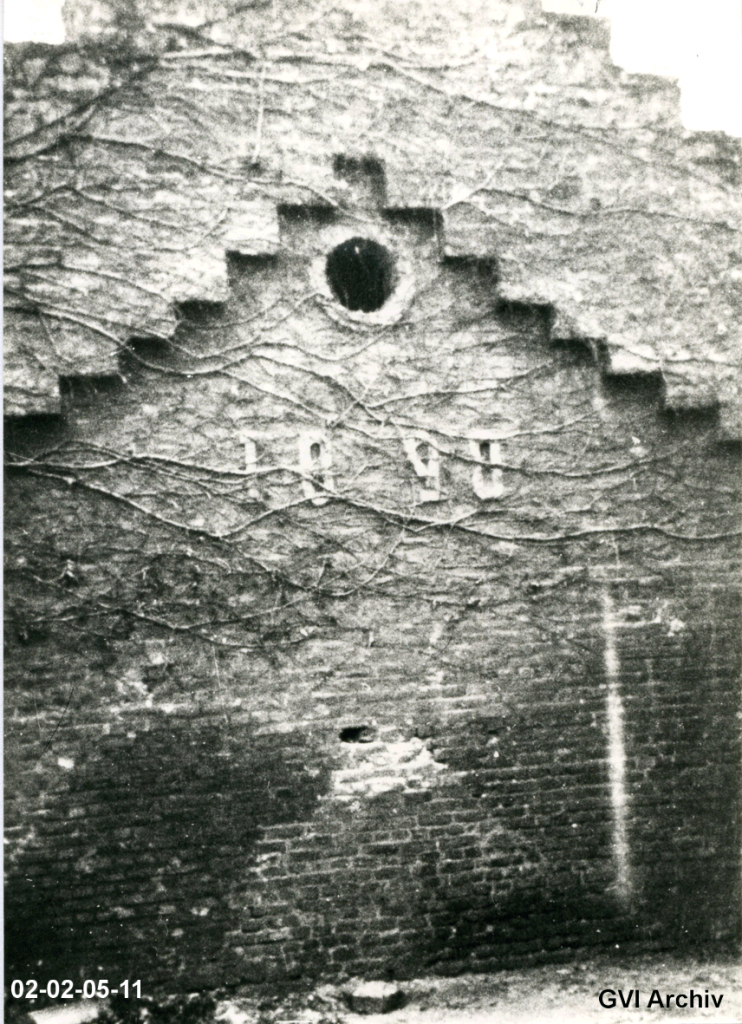
In addition to the 5 large manors in the village and a so-called „Pannhaus“ (brewery), this mill belonged to the noble lords of Frenz. It was one of the properties of the noble lords of Frenz and was operated as a grist and oil mill.
It goes back at least to the year 1456, according to which the inheritance of the Weisweiler knight Werner von Palant was divided among his eight children and the moelen zu vrayntzen fell to the son Emond.
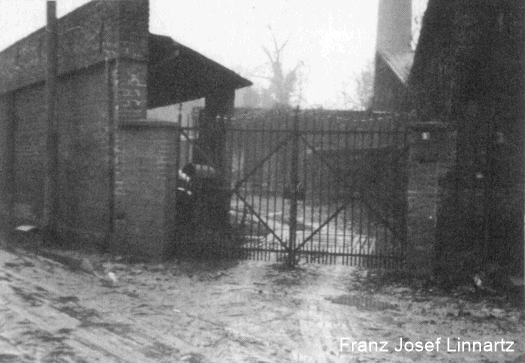
Many years later, presumably on the same site, an artificial wool factory was established in 1890, operated by the factory owners Carrier and Baum.
Artificial wool was refined there, which was carbonised, washed and dyed as raw material. Also so called. Plaster and shredding wool was also produced.
In good times, up to 60 people were employed there; mostly women.
The machines were driven by a water turbine, which was supplied with water from a tributary of the Inde River (popularly known as the „Disch“), which ran directly in front of the factory premises. However, if the Indewater became scarce due to hot weather, a special boiler and a locomotive served as a drive unit.
The processed raw material was transported by a carter with horse and cart to the local railway station for shipment overseas.
In 1904 they built a villa-like building (later known as „Villa Baum“) in the Feldgasse as their residence, which still exists today. A few photos show the old factory complex
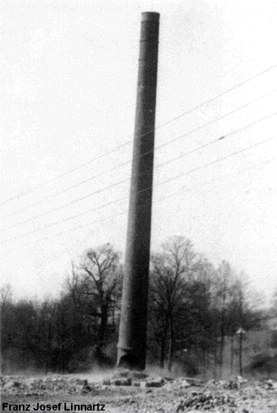
When the 42-metre-high chimney was blown up at the beginning of 1963, a piece of very old Frenz history shattered with it.
After the remaining parts of the former factory had been demolished, an area of 4,500 square meters was available, which after leveling served as an open space for recreation for the general public with lawn, fountains and benches.
At the same time, a sufficiently large area was asphalted, which was available for years for the showmen as a parking space for the funfair stalls on the occasion of the annual Schützenfest.
The marquee itself was somewhat hidden, where the Iven family has built their family home today.
Only a few years later, a large children’s playground was built on the same site.
The fairground and the location of the marksmen’s tent remained for a few more years until this was then moved to the site of the sports field.
The development in its present form began in the 1970s. However, the playground had to move to the right and was considerably reduced to its present size.