The Resettlement of Pier
The resettlement of Pier is a prime example of how not to approach the social impact of resettlements! As early as 1958, the residents of Pier were grappling with the prospect of resettlement as the future of opencast mining took shape, a process that continued in 1969 with the Inden opencast mines (I and II). Since 1935, Pier had been part of the Lucherberg administrative district, which comprised the municipalities of Lamersdorf, Lucherberg, Luchem, Frenz and Schophoven. With 1,788 inhabitants, it was the largest municipality. Covering 9.76 km², it was even the largest locality in terms of area within the municipality of Inden, formed in 1972, accounting for 27 per cent of its total area.
In 1983, when the Cologne District Government was preparing for the resettlement of Inden, Altdorf and Pier by conducting a survey on possible resettlement sites, 68 per cent of Pier’s residents took part in the survey. This was a sign that the people of Pier wanted to shape their own future. However, they did not vote for a site within the municipality of Inden. 56.6 per cent of those surveyed opted for the resettlement site in the neighbouring municipality of Langerwehe. For the first time in the history of resettlement in the Rhenish lignite mining area, two resettlement sites were designated in the 1990 Lignite Plan: Langerwehe-Jüngersdorf and Inden-Lamersdorf. However, contrary to the decision of the Lignite Committee, the responsible Environment Minister of the State of North Rhine-Westphalia ruled in 1990 that Pier was not to be resettled at the same time (1990–1999) as Inden and Altdorf, but later – between 2005 and 2015. Prof. Zlonicky’s expert report concluded that the staggered resettlement would be socially acceptable. The decision was to be left to the generations being resettled. This came as a shock not only to the community of Inden, which feared for its existence due to the loss of its residents, but also to the people of Pier. The mining operator was not permitted to purchase any property in Pier until 2005, except for so-called ‘cases of hardship’.
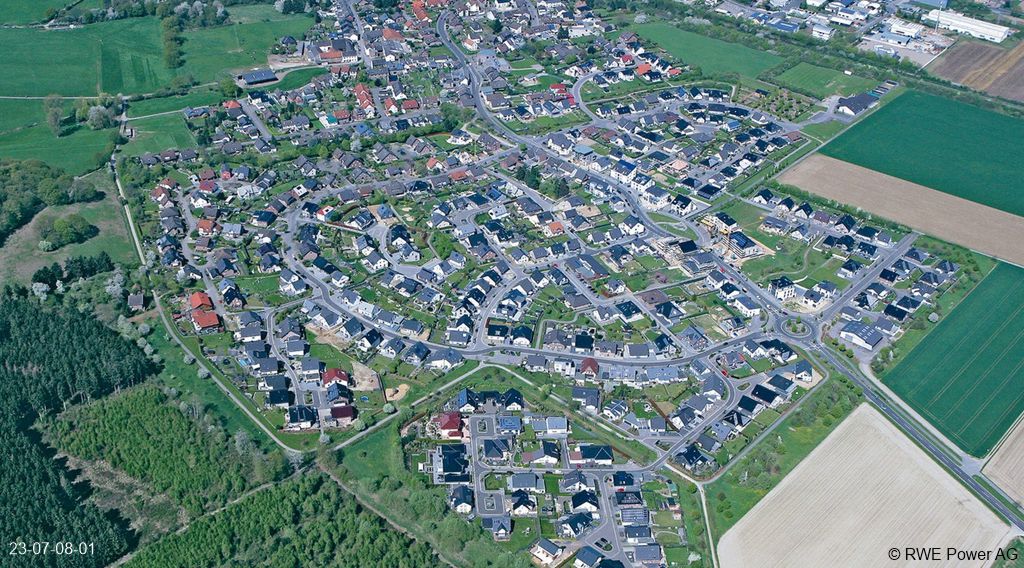
Whilst the resettlement site in Langerwehe was being developed, the municipality of Inden developed the ‘Gut Müllenark’ building site in Schophoven and the ‘Waagmühle’ site in Inden/Altdorf to retain the residents of Pier. By the time resettlement began in 2005, only 1,142 of the original 1,788 residents remained in Pier. 36 per cent of the residents had already moved away for professional or family reasons, particularly the younger generation. As the property market had ground to a halt, they let out their houses; a few were ‘fortunate’ enough to be able to sell them. Rheinbraun was ‘permitted’ to purchase houses only in 12 recognised cases of hardship, via a so-called hardship committee, in the period up to 2005. On 24 April 2004, the Dürener Zeitung reported that the first 30 houses in Pier were to be demolished, even though the collective resettlement had not yet begun. In addition to the loss of residents, this led to significant shifts in the demographic structure and the breakdown of the village community and community life, but above all to the disruption of people’s personal and private life plans. The key argument put forward by the expert Zlonicky (1988) in favour of a phased resettlement – “… the concept of collective resettlement, i.e. bringing all residents back together at a single location, is socially acceptable…” – had already become unachievable due to the ongoing population decline. In a further survey conducted in 2001 by the Cologne District Government, 23 per cent of households in Pier favoured the site in Schophoven, 44 per cent favoured the one in Langerwehe, 12 per cent wished to remain in Inden, and 18 per cent did not provide any information. In line with these results, the lignite mining plan designated only the resettlement site in Langerwehe for Pier, and none in the municipality of Inden. The resettlement of Pier began on 1 March 2005; it was declared complete in 2013. As early as 2005, the resettlement site in Langerwehe was given the place name ‘Pier’; it was listed under both names until excavation began. The Diocese of Aachen decided not to build a replacement for the Catholic Church of St Mary of the Immaculate Conception in Pier. The bell at the Waagmühle is a relic of this church. At the resettlement site in Langerwehe, an existing chapel was extended and a cemetery was established. The Langerwehe local council funded a community centre. Several clubs are active in Langerwehe. The football club FC Victoria Pier and the mandolin choir declared their support for Schophoven in 2004. In Schophoven, an active community life has developed alongside the people from Pier, centred around the village square and the Catholic Church of St Barbara. It is said that 30 per cent of the people from Pier settled in Langerwehe, 27 per cent in Schophoven at ‘Gut Müllenark’, and around 15 per cent found their new home at ‘An der Waagmühle’ in Inden/Altdorf.