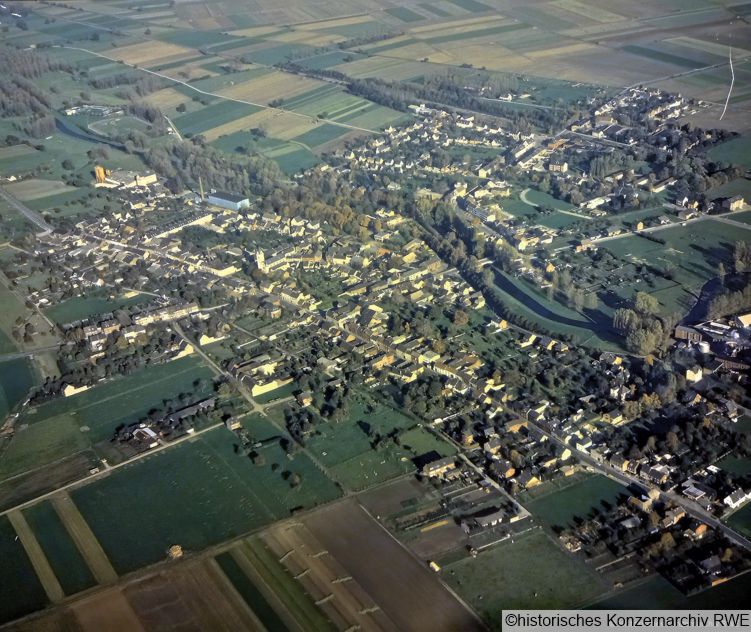
Memories of Inden
Several Roman estates and Frankish burial grounds have been discovered in and around the village of Inden; these were remarkable both for their number and, in some cases, for their size. Further research is needed to determine whether this indicates continuous settlement. From the High Middle Ages onwards, the Counts, and later the Dukes of Jülich, shaped the lives of the people here for centuries. Inden, Altdorf and Kirchberg formed a ‘Dingstuhl’ – a judicial district – where lay judges from the villages administered justice and managed civil community affairs. Inden, together with Altdorf and Pattern, belonged to the parish of Geuenich, where the parish’s mother church is situated. In Inden, the Cologne Cathedral Chapter maintained a court with a chapel in 1220.
Between 1568 and 1714, the Duke of Jülich was frequently used as a transit route by a wide variety of warring armies. The surrounding countryside of Jülich was plundered over a wide area, both by its own troops and by the occupying forces. For the rural population, this meant robbery and pillaging, murder and rape. The hordes of mercenaries brought not only hardship, misery and famine, but also epidemics such as dysentery, the plague and cholera.
With the invasion of the French Revolutionary Army in 1794, the days of the Duke of Jülich were numbered. Things that had previously been unthinkable were now becoming possible. This included the dissolution of the Geuenich parish. Pattern and Inden became independent parishes, but Altdorf did not. And this caused conflict. More on this at stop ‘S06 Geuenich’.
In 1799, Inden had 706 inhabitants. Under Prussian rule in the 19th century, the previously agricultural village developed into a rural economic centre of regional importance. The Reformed community established its own congregation, built a church and set up its own school. A doctor and a chemist set up practice, a post office was opened in the village, and trade and crafts flourished. Its location at the junction of the Düren–Aldenhoven and Jülich–Eschweiler provincial roads proved to be a strategic advantage. The village streets were paved and bridges were built. The Stolberg–Jülich–Mönchengladbach railway line was built in 1873 and remained in operation for 110 years. Inden was given a railway station. The local industrial enterprises expanded, and new ones settled in the area, creating many jobs. 1894-1897 a new, larger Catholic church was built to replace the old Domhof Chapel, as the population had doubled. The cross at this site is the high cross from the former cemetery at Inden Church.
A water main came into service in 1912, and in 1927 the Düren–Pier tram line was extended to Inden. The ‘convent’ of the Cellite Sisters, comprising award for the sick and new mothers, a care home for the elderly and a nursery, was built in 1929.
The slogans of the National Socialists found ardent supporters in Inden from an early stage. The Second World War, triggered by the Nazi regime’s megalomania, took a heavy toll. The fighting between American and German troops over the Inde and Rur river crossings in the autumn and winter of 1944–45 left large parts of the region in ruins, including Inden. After half a year of evacuation, those returning home in 1945 found their hometown severely devastated. Ten years after the end of the war, the destroyed houses had been rebuilt, and new housing estates were springing up. However, local industry never fully recovered. From 1955 onwards, schoolchildren were able to attend the new primary school, the ‘Parkschule’. It stood on the site of the villa belonging to the Jewish industrialist Walter Lichtenstein, who had managed to flee to Switzerland.
The new Weisweiler power station and the work on the ‘Inden open-cast mine’, which began in 1956, provided jobs on a scale never seen before. Inden’s population rose to 2,300.
In June 1981, the first information sessions on the resettlement programme began; the resettlement itself commenced in 1991. By 1999, all residents had left the village and the resettlement was complete.
16 January 1998, 12.00 noon. An excavator bucket tears down the tower of the Protestant church on Mühlenstraße. The ‘Klömpche’, as it was affectionately known locally, is no more.
17 June 2000, 10.00 am. The first blow of the wrecking ball against the tower of the Catholic church sends a shiver down the spines of onlookers
The cross at this location is the high cross from the former cemetery at the Church of the Inden.