Industry and Trade
Despite its predominantly agricultural character, Inden was notable for its substantial concentration of industrial enterprises. The soft water, the driving force of the River Inde, and the Jülich plain – a growing area for flax and glue – were decisive factors in the establishment of the paper industry, rag-sorting plants and the leather factory. As early as the 16th century, paper mills had established themselves in Lamersdorf and Inden on the sites of former mills.
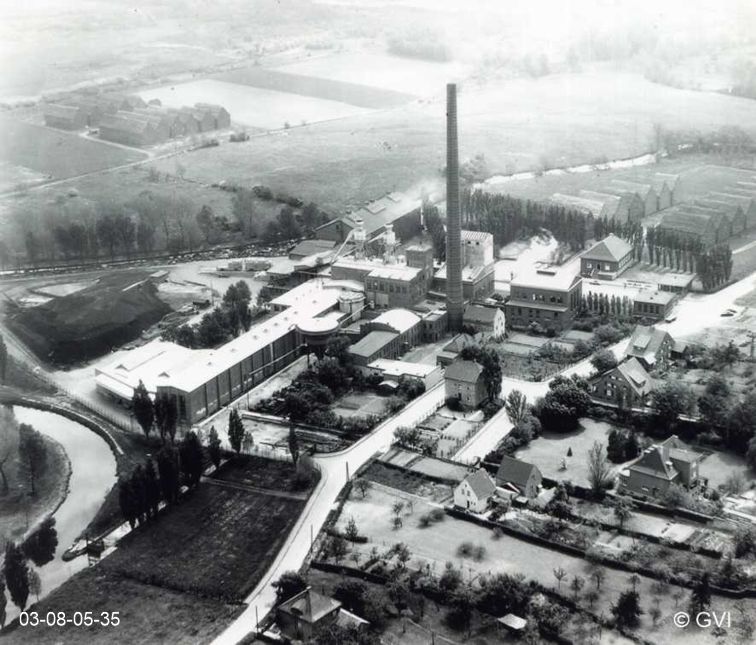
As early as 1537, a dye mill is said to have stood on the site of the paper mill in Inden, where blue dye made from woad was produced. In the 18th century, the site of the woad mill was referred to as an oil mill, which processed local rapeseed into oil. In 1763, it was converted into a paper mill. In 1816, the owner of the Lamersdorf mill, Carl Heinrich Engels, acquired the paper mill and, in 1863, installed the first paper machine in the Jülich district, as well as the first steam engine for drying the paper in the same year.
Ownership and management changed frequently. In 1921–22, the modern-day detergent group Henkel (Düsseldorf), which had its origins in Aachen, acquired the straw paper and lid factory. Following extensive refurbishment and new construction, it began manufacturing its own packaging materials there from 1923 onwards. In 1965, production switched from straw to wastepaper. In 1981, the plant – covering approximately 7 ha – was due to be closed, but it was acquired by ‘C. D. Haupt Papier- und Pappefabrik’, a family-run business based in Diemelstadt-Wrexen (Waldeck-Frankenberg district in Hesse). In 1989, the factory became part of the Jefferson Smurfit Group (headquartered in Dublin, Ireland) under the new name ‘Smurfit PKI Inden’. The local authority was unable to offer any alternative sites for the factory within its boundaries. The timetable for the lignite mining plan was amended, meaning that the factory did not have to be relocated until 2030. In 2002, turnover declined; the company ceased trading, the last batch of paper was produced, and the production facilities were dismantled and sold. This marked the end of a 200-year industrial history.
In 1873, Inden gained its own railway connection, linking the textile industry strongholds of Mönchengladbach, Aachen and Düren. Around 1903–06, two rag sorting plants were established in Inden (W. Heymann & Co.) and Pier (A. Heymann & Co.), situated at the geographical centre of this network. They were not only suppliers to the region’s paper and textile factories. With 200–300 employees each, they were among the largest employers and taxpayers in the municipality of Inden. The owners were Jewish; the businesses were ‘aryanised’ in 1938 and, following their destruction during the Second World War, were neither rebuilt nor recommissioned.
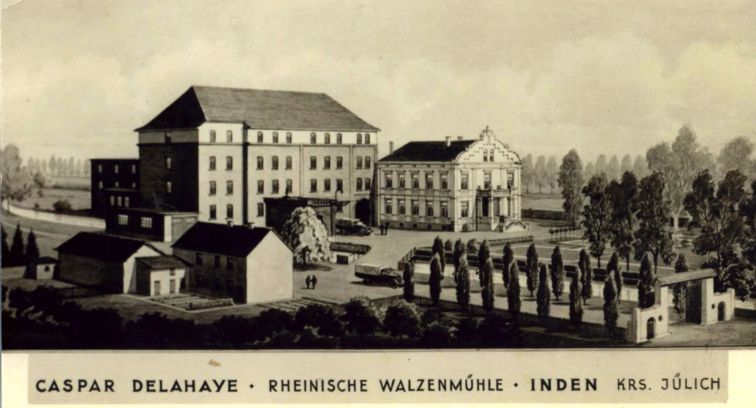
On the mill pond by the River Inde stood the Delahaye Mill, formerly a malt factory and later a goods distribution centre where grain and agricultural produce were handled. It closed following the resettlement.
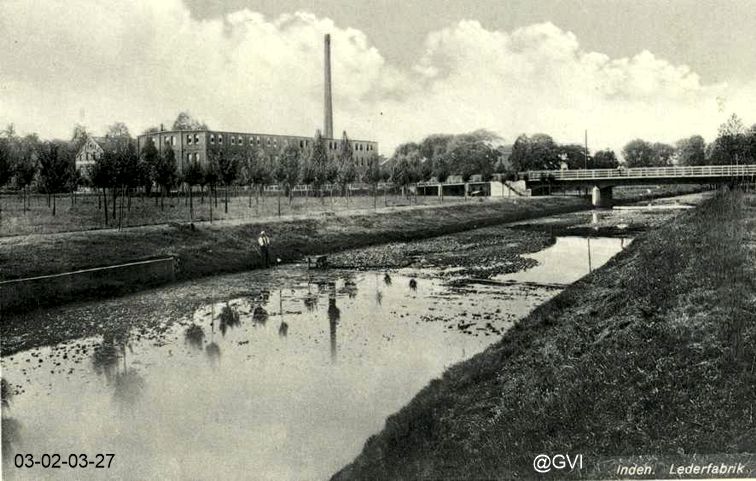
In its vicinity was Friedrich Wilhelm Lauffs’ leather factory, which had been established as a tannery by the mill pond around 1880. Production there ceased after the Second World War. A toy warehouse was still located in one part of the large hall in the early 1990s. Inde Plastic GmbH operated in the other part. It relocated its production to the Aldenhoven industrial estate around 1995. Following the resettlement, the municipality of Inden no longer has any of its traditional industrial enterprises.
A separate 3-hectare industrial estate was designated for the businesses affected by the relocation, accommodating around 40 firms, where primarily construction companies and craft businesses with storage facilities were able to set up. Due to the environmental impacts, they caused (noise, traffic), a mixed-use development within the town of Inden/Altdorf was not permitted under planning law. Mechanical engineering firms based in Inden and Pier, such as H. Löwenkamp Maschinenbau GmbH (Pier), B. Grobusch (Inden) and the Schwieren joinery (Inden), relocated here. The firm Gebr. Quast in Pier moved to Eschweiler as part of the relocation.