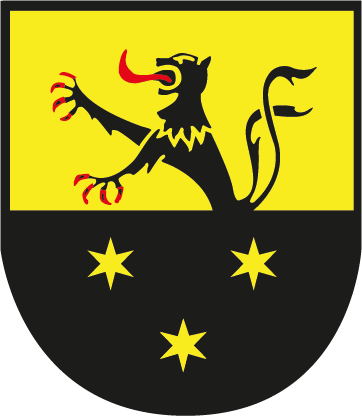
Memories of Altdorf
Archaeological finds show that the site of Altdorf has been inhabited, at least sporadically, since the Linear Pottery culture period around 5500 BC. The site has been continuously inhabited since Roman times, as evidenced by several ‘matron stones’ – votive stones erected during the Celtic period.
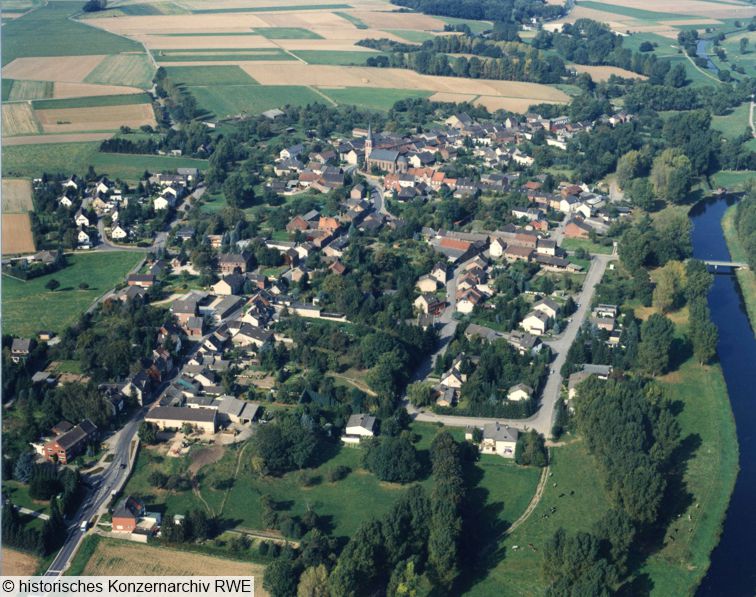
In the Middle Ages, there were various spellings, all of which can be traced back to the Latin terms ‘Alta ripa’ – ‘high bank’ – or ‘Ad alta ripam’ – ‘towards the high bank’. Over the centuries, this evolved into the name ‘Otorp’, which was later ‘scholarly’ restored to ‘Altdorf’.
The early modern period was, overall, a very turbulent time in our region, marked by great hardship and deprivation. It began with the Wars of the Reformation. Once these had ended, the Jülich Wars of Succession broke out and the tribulations continued. Jülich was besieged twice, and it was the surrounding villages that suffered the most during all these conflicts. The numerous acts of reprisal forced many farmers, and indeed the community itself, to sell or mortgage their last remaining land in order to pay the sums demanded. Added to this were the terrible years of the plague from 1665 to 1669, which claimed the lives of many people.
After a century of relative tranquillity, Altdorf was struck by disaster. On 2 August 1856, a fire broke out in the village. A chronicle reports: “As the thatched roofs were completely dry due to the heat of the sun, the fire spread with extraordinary speed. Before help could arrive, the whole village had already caught fire in various places, some of which were quite far apart. The church, school and 24 houses, along with their barns and stables, were consumed by the flames.” The village was rebuilt at great cost and was able to develop once more into a tranquil, agricultural community.
Things took a turn for the worse for Altdorf when the Inde and Rur valleys became a frontline area during the Second World War, from autumn 1944 onwards. As early as 3 September 1944, the first shells fell on the village. From then on, shelling and bombing raids followed one after the other. On 19 November 1944, the forced evacuation of Altdorf was ordered, as remaining in the village any longer would have cost many lives.
As early as 28 November 1944, the village fell into American hands. Whilst it was still dark that morning, the Americans, advancing from the direction of Aldenhoven and Pattern, had entered the village. This attack caught the German troops at this location off guard, and they abandoned the village without putting up any significant resistance.
After the war, Altdorf developed into a village well worth living in. Like Pattern and Kirchberg, the village was an independent mayoralty within the Inden district. As part of the local government reorganisation, Altdorf was incorporated as a district into the new municipality of Inden with effect from 1 January 1972.
In the 1980s, with the impending resettlement in mind, the first residents began selling their houses and moving away. Many stayed in the Inden area and found new homes in the surrounding municipalities, whilst others moved further afield – one farmer even as far as the Baltic Sea.
With the sale of the houses to RWE, the character of the village had changed fundamentally. The purchased houses were gradually demolished. As a result of the demolition, the formerly continuous streets became increasingly dotted with gaps, making it ever more difficult to find one’s way around the village. Many older residents later stopped visiting the village because they wanted to preserve their memories of it in its entirety.
With the official end of the resettlement on 4 September 1999, the village of Altdorf also ceased to exist. Today, it lives on only in the memories of its former residents or in old photographs.