Merödgen Estate, School and Sports Centre
Farms and settlements with names suggesting they originated from cleared land were mostly established between the 10th and 14th centuries. This is also the case with Merödgen, which means ‘my little clearing’. Merödgen is first mentioned in a document in 1341. For centuries, the owners of the estate held the office of hereditary forester for the Wehrmeisterei. Through marriage and inheritance, the respective owners also came to own farms in Inden, Luchem and Frenz.
Through marriage, the Frenz farm passed to the von Goltstein family of Breyell Castle near Nettetal in the mid-16th century. The von Goltstein family of Frenz and Merödgen embraced the Reformed faith at an early stage. Church services were held here for many years. The Reformed congregation of Inden, founded in 1823, chose the name ‘United Evangelical Congregation of Inden, Merödchen and Vercken’.
Carl Baron von Goltstein of Frenz, Merödgen and Beeck played a special role in the later history of our congregation. In 1821, he laid the foundations for lignite mining in the west of the Rhineland. More on this at stop ‘N06: The Beginnings of Lignite Mining in the Western Mining District’.
Although Baron von Goltstein lived and worked at Haus Merödgen, the estate itself belonged to his sister, Charlotte, Baroness von Goltstein. Through her descendants, the estate eventually passed to the von Zandt family at Seehof Castle near Bamberg. The last resident from this family was Emi, Baroness von Zandt, who died in Merödgen on 9 April 1944. In April 1945, the Merödgen manor house burnt to the ground
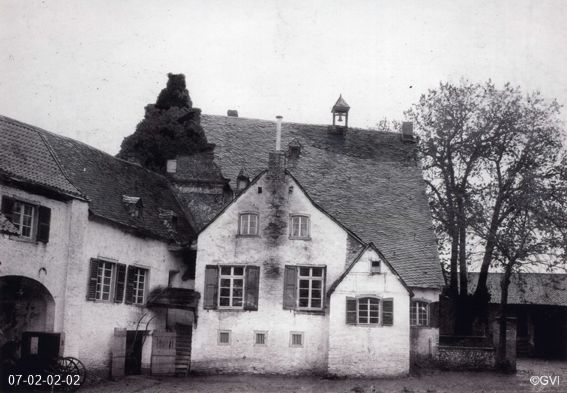
Gut Merödgen, courtyard around 1900/1910. The mansion with bell tower and step gable. On the left the gate house with passing carriage, then to the right residential building, a resource entrance with stairs to the kitchen building. On the right the terrace with walnut in front of the main entrance.
In 1963, Merödgen was sold to Rheinische Braunkohlewerke AG, which in turn sold it to the then Lucherberg district authority. The acquisition of the Merödgen estate laid the foundation for the development of what is now the municipality of Inden.
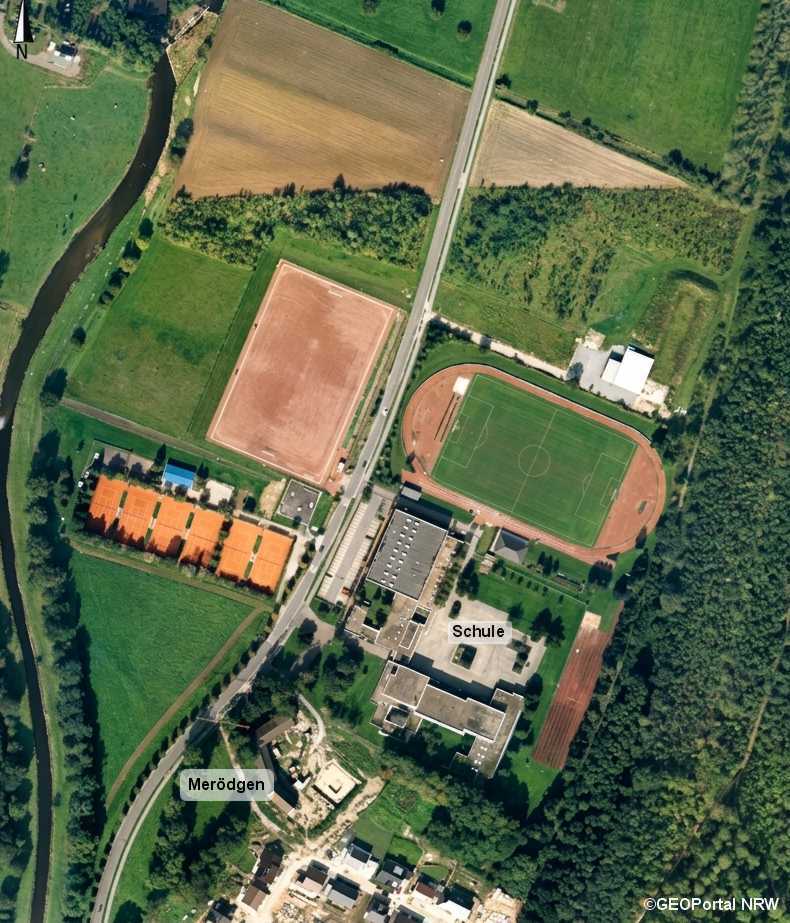
With a view to a future reorganisation of local authorities, the municipalities of Altdorf, Inden, Frenz, Lamersdorf, Lucherberg, Pier and Schophoven joined forces across district boundaries in June 1968 to form the ‘Inden-Lucherberg School District’. By June 1972, the ‘Merödgen School Centre’ – originally a three-form-entry comprehensive school – had been built on the site on the northern side of the estate. The spacious sports facilities were constructed to replace the sports grounds that had been lost in the resettled villages.
In 1989, the lease with the long-standing tenant family came to an end.
The Inden local authority’s plans for a youth centre were not realised due to cost considerations. In 1993, the construction company Schüssler GmbH & Co. KG from Jülich acquired the farmstead to realise the ‘Gut Merödgen Residential Complex’ project here in cooperation with the Caritasverband Düren-Jülich e.V.
The listed buildings were extended to include a new multi-storey building, thereby restoring the historic cohesion of the farmstead. Both individuals and families now live here in 52 flats of varying sizes.
The former barn was converted into the ‘Gut Merödgen’ hotel and restaurant, which operated from May 2000 until the floods in July 2021.
Today, the former hotel and restaurant is used to house refugees.