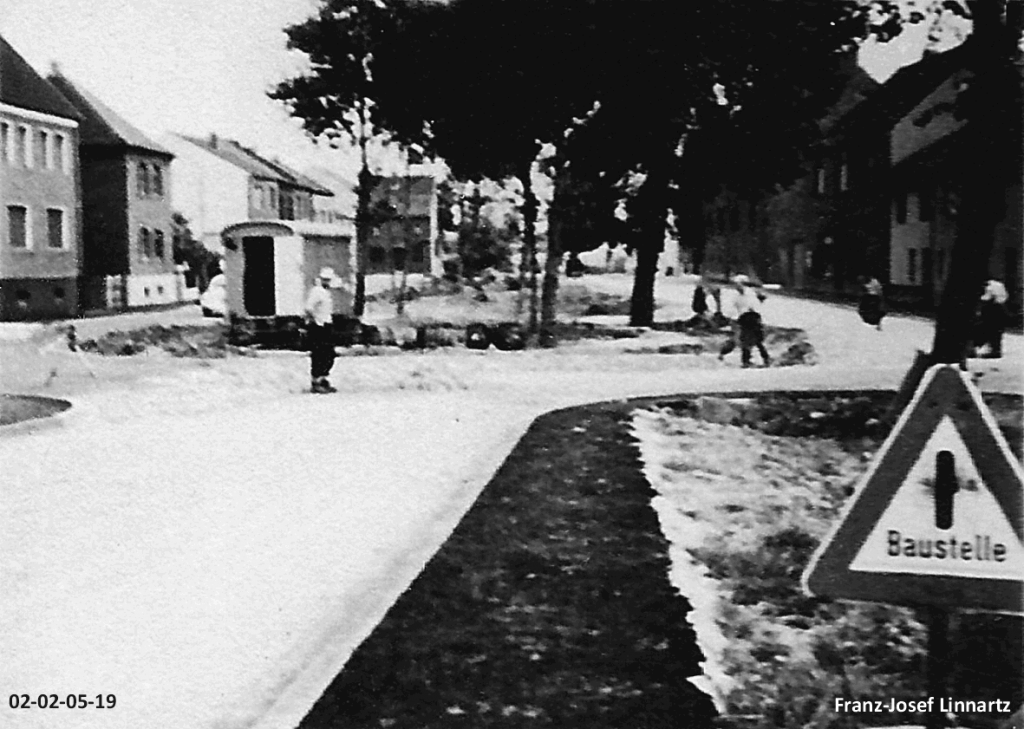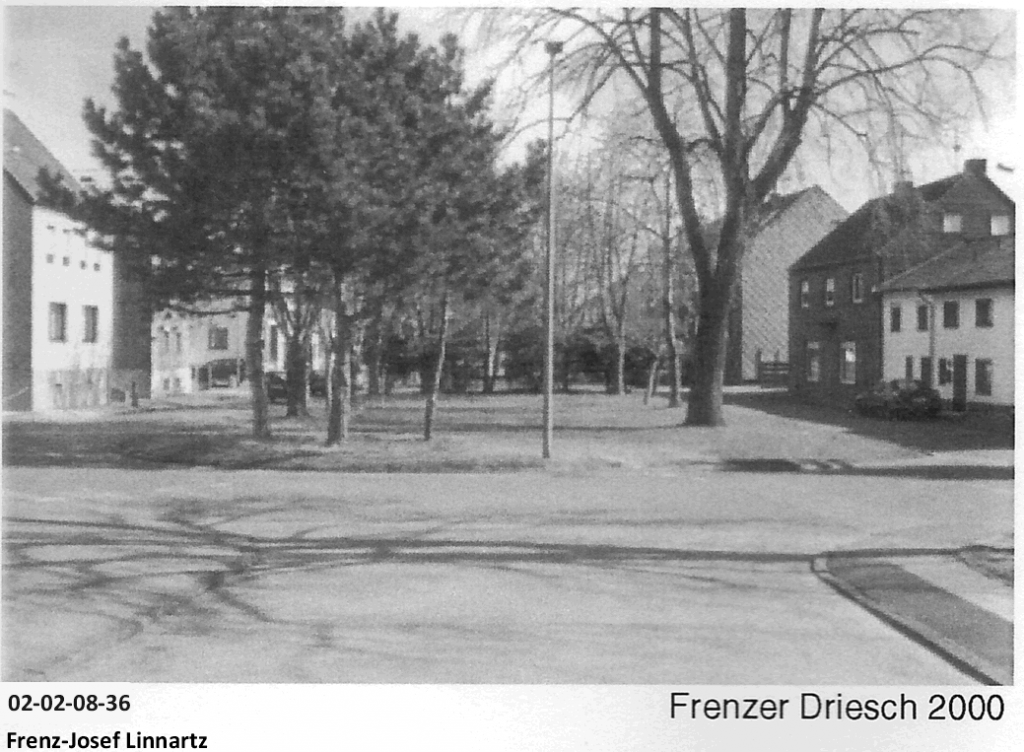
The Frenzer Driesch
The word „Driesch“ in its original meaning means „swamp“, which could be drained and then cultivated. Behind this part of the village there is still a field called „Sures“; probably a swampy lowland which caused the soil to turn sour through constant wetness.
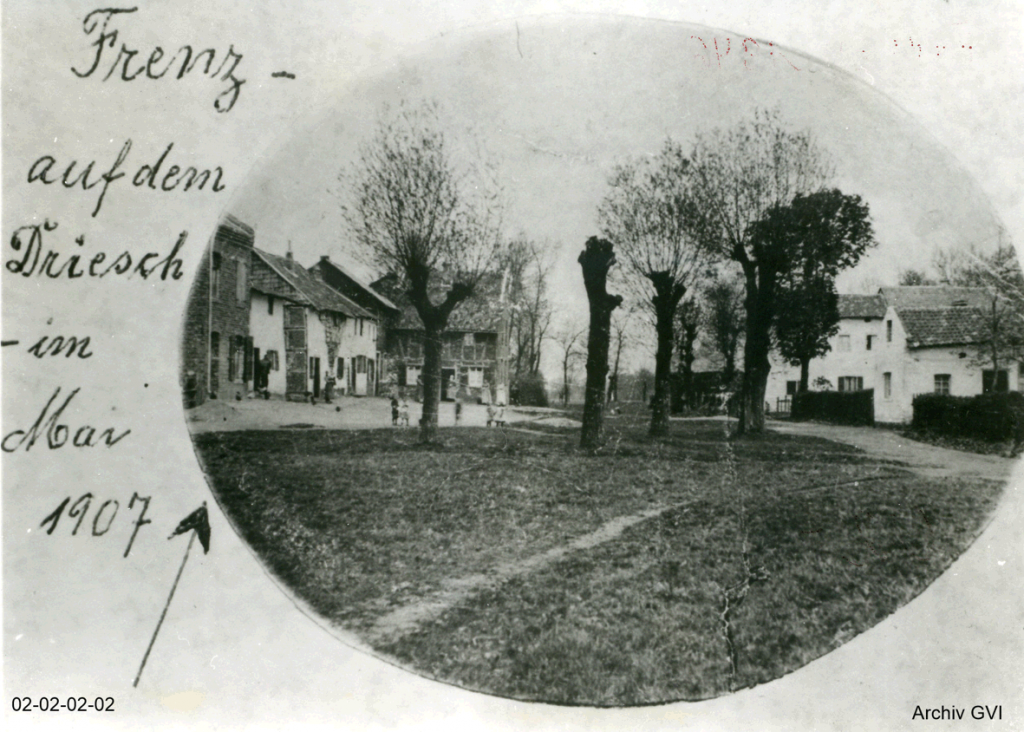
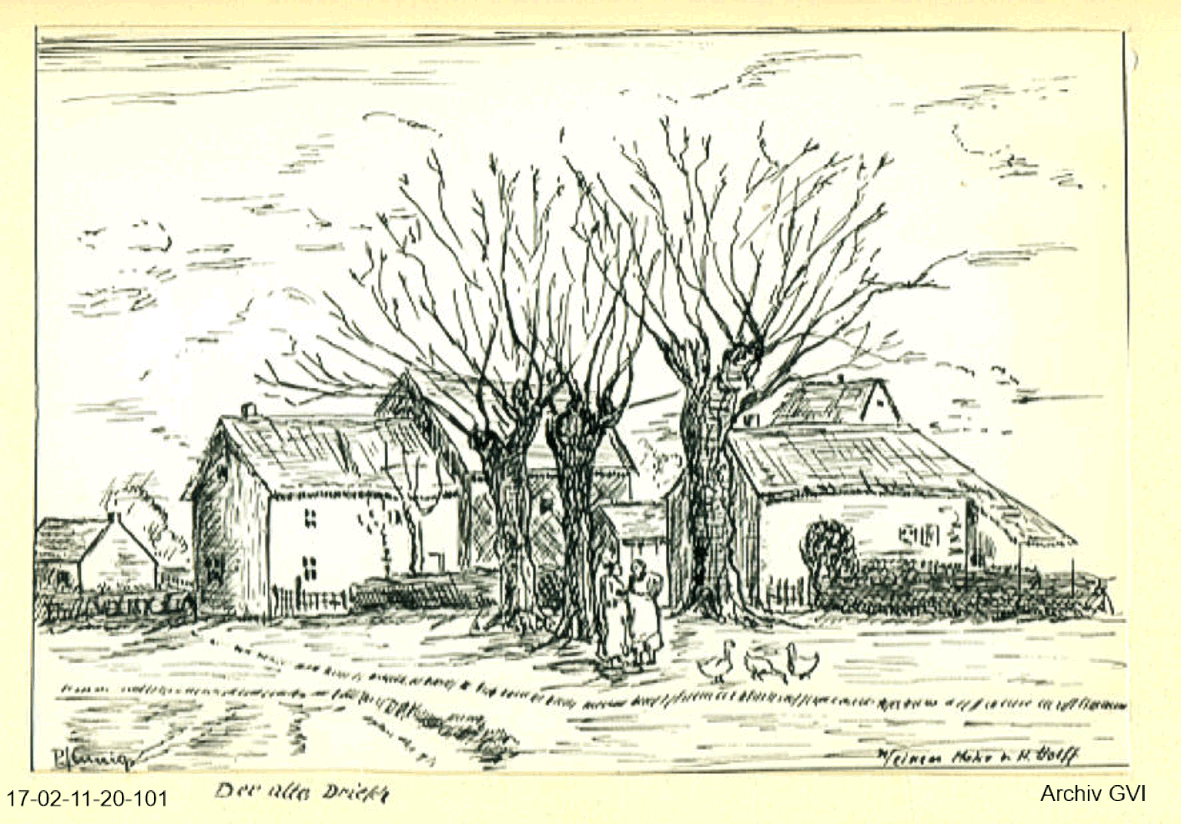
The layout of the houses suggests a so-called „Angerdorf“. The layout of the houses suggests a so-called „Angerdorf“ (village with a square in the centre), the characteristics of which are given by an entrance and an exit.
This also included a watering place, a well or a pump, which was located in the centre of this part of the village, as can be seen on a tile of the carnival society Frenzer Burgnarren.
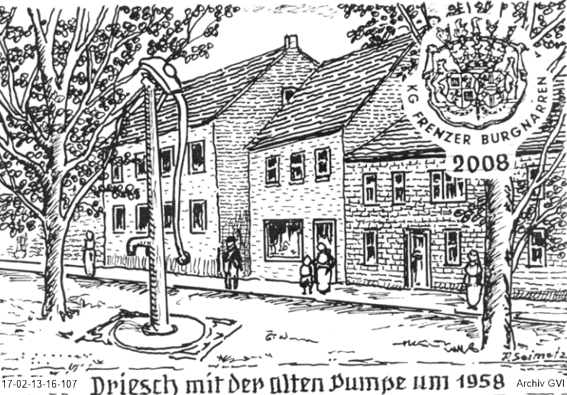
Before a pump was built on the Driesch, however, a well stood in its place. The pump was not built, however, until a child fell ill with typhoid fever and the illness was attributed to dead chickens, which were said to have been found in the well.
Considering the geographical location of the district „Frenzer Driesch“, one could assume that it would not belong to the actual village, as it is separated from the „main village“ by the course of the Inde River and can only be reached via the bridge.
The dwellings were probably feudal houses of the Frenz castle and the inhabitants were serfs of the noble lord for whom they had to work in the castle in earlier centuries. It may therefore be understandable that the settlement took place on this side, i.e. in front of the course of the Inde and not behind it, in the actual village, so that in the event of floods (and there were many such floods) one could not be cut off from one’s place of work at the castle.
However, the castle referred to here was not the one on the Burgberg next to the church, but the former moated castle towards Langerwehe, built by the noble family of the Lords of Merode in the 16th and 17th centuries and owned by the former lordship of Frenz from 1361 until 1825.
The inhabitants kept cows, sheep and mainly goats on their land, which was allotted to them by the lord of the castle. Hence the name „Geeßedreesch“ („Goat Driesch“), a rural triangle bordered by the Inde River, the pond and the extension of the Unterstraße.
In ancient times, the Driesch was also the place where the court of lay assessors met and held its sessions. It is interesting that the court date was announced 8 days in advance in the church so that no one could miss it.
The regulations stated that the court was not to be held after lunch. The time was fixed from 8 am to 1 pm in winter and from 7 am to 1 pm in summer.
There is oral evidence that witches were even burned at the Driesch in the 17th century. It is also said that Frenz marksmen executed a condemned man on the Driesch.