Remembering the Jewish residents
Jewish citizens also lived in the municipality of Inden for generations right up until the Nazi era (1933–1945) – primarily in the villages of Frenz, Inden and Pier. There are no Stolpersteine (commemorative stones set into the ground) marking the flight, expulsion, deportation or extermination of our Jewish citizens during this period. Most of the ‘original sites’ had to make way for lignite mining.
It is no longer possible to determine conclusively when Jews first settled in the villages that now make up the municipality of Inden. The earliest recorded references date from the year 1701, when a Nathan Levi lived in Pier-Bonsdorf and a Voss Levi worked there as a butcher. In Frenz, too, the ‘Neu-Judt’ are mentioned in a tax assessment notice for the first time. Most Jewish families lived in the villages of the Lucherberg district: Frenz, Lucherberg, Lamersdorf and Pier. The Jewish families Cohen, Voss, Meyer, Hermann and Pszyrowski had been rooted there since the early 19th century. Part of the Levy family moved to Lucherberg. The Cahn family lived in Pier from 1871 until 1938, the year in which their butcher’s shop was ‘Aryanised’. The Bloch family also settled in Pier, as they worked at the rag sorting plant run by the Jewish entrepreneur Abraham Heymann in Pier.
Far fewer Jews lived in the villages within the Inden district, which included Pattern, Kirchberg, Inden and Altdorf. There is no evidence of any Jews in Altdorf or Pattern. Gustav Keusch (born 1907) and Louis Levy Cohen (born 1907) settled in Inden and ran a butcher’s shop on the corner of Hauptstraße and Neustraße (also known as ‘Senksch Eck’). With the economic downturn, some families moved to Jülich, Düren or Cologne, as they could also attend synagogue there. Frenz and Pier had only one prayer room. There is a small Jewish cemetery in each of these towns.
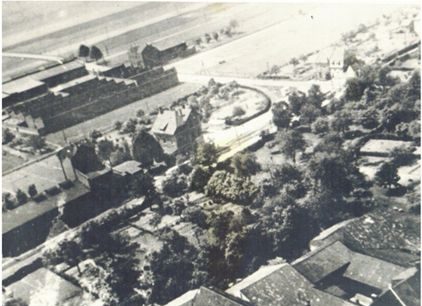
Special mention should be made of two rag-sorting plants that were established in Inden and Pier at the beginning of the 20th century. Alongside the paper and leather factory in Inden, they were the largest businesses, employers and taxpayers in the community. Each employed between 200 and 300 staff – mostly women – and financed the tram line from Düren via Pier to Inden.
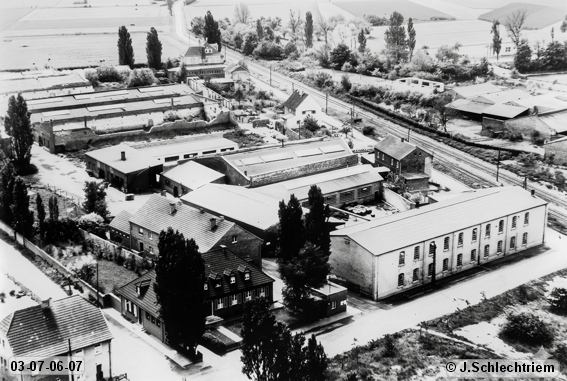
As Inden had had its own railway connection since 1873, they were able to transport their rags, cloth and other goods to the cloth factories in Aachen, Mönchengladbach and the Netherlands, as well as to the ports of Neuss and Antwerpen. Both rag sorting plants – A. Heymann in Pier and W. Heymann in Inden (which were not related to one another) – were owned by Jewish entrepreneurs (Walther Lichtenstein, Abraham Heymann) who were originally from Cologne.
There is evidence that the first local branch of the NSDAP was founded in Inden, in the former district of Jülich, as early as 1930. Leading officials in the district of Jülich came from Inden. It is therefore not surprising that, following Hitler’s seizure of power in 1933, National Socialist methods became increasingly evident. As early as 1933, W. Heymann was ‘gradually’ ‘Aryanised’, a process that was completed by 1938. The owners of the two companies managed to flee with their families to Switzerland and England respectively. They survived; some family members perished in the Shoah. Only Walther Lichtenstein was able to regain his company, W. Heymann, after the war as part of the reparations process. He spent the rest of his life in Basel (Switzerland) and never set foot in Inden again. Abraham Heymann’s family remained in England.
By 1937, there were no longer any Jews living in Inden; from 1941, there were none left in Frenz, Pier or Lucherberg either. The Jews from the Lucherberg district were deported to the concentration camps via the assembly camps in Düren (Gerstenmühle, Thuirsmühle). In the village of Kirchberg, which belonged to the Inden district, was the Jewish assembly camp Villa Buth, a former villa belonging to the Carl Eichhorn paper mill. From there, around 150 Jews were deported to the concentration camps. An unusually large number of Jews from Inden are listed as ‘missing’; their fate can no longer be ascertained. It is known that the Cahn family, who lived in Pier, were ‘taken away’; the same applies to the Psrzyrowski and Hermann families from Frenz.
In their memory and as a tribute to them, this plaque is dedicated to all Jews born in our towns who perished in the Shoah. A Jewish proverb says, ‘… for only the forgotten are truly dead.’ The names of those who perished in the Shoah can be found in the supplementary information accompanying this plaque on the internet.