Protestant Congregation
Before the resettlement, around 10 per cent of the population in the municipality of Inden were Protestants; a diaspora within the Catholic Rhineland. It has a long history: in the 16th century, the noble houses of Ahr in Pattern, Vercken and Pesch in Pier, and Merödgen near Lamersdorf were among the first supporters of the Reformation. They belonged to the Reformed Congregational Synod of the Duke of Jülich, which had been formed in 1611. From 1634 to 1649, a certain Wilhelm Nobis from Inden – a brother of the churchwarden of the Catholic church in Geuenich – served as minister of the Reformed congregation of Jülich at Haus Ahr in ‘Geusen-Pattern’. The term ‘Geusen’ was used to describe Protestants who came from the Netherlands. They were forbidden to build a church; services were held in private homes. In 1777, a group of fathers joined forces and commissioned the private tutor Mr Schick from Hörstgen to teach their children.
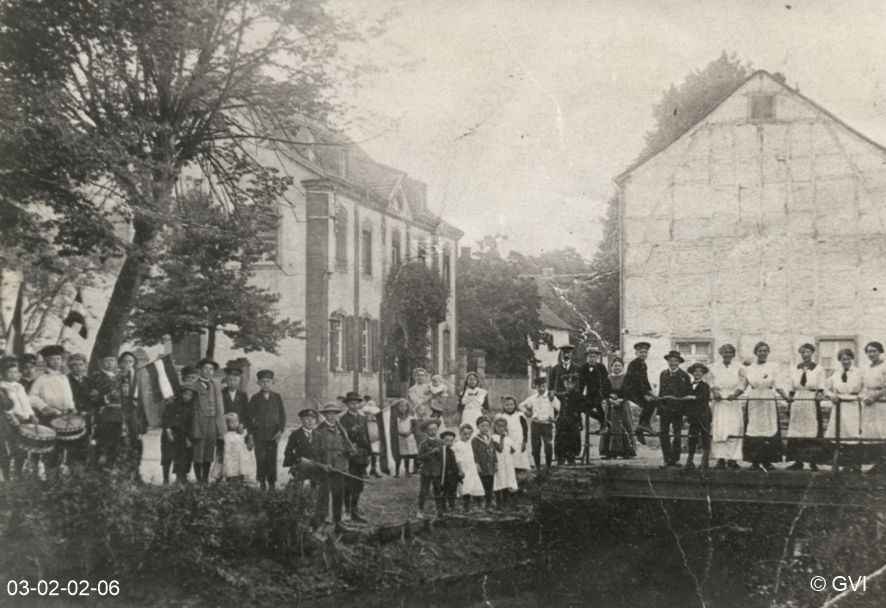
In 1782, Major-General Kling of Jülich from the Palatinate, commander of the fortress at Jülich, appointed his non-commissioned officer Schweitzer, also from the Palatinate to the post of schoolmaster. In 1788, on the general’s behalf, Schweitzer purchased a plot of land in Inden (on the corner of Kirchstraße and Mühlenstraße) to build a Protestant school. It was known as the ‘Generalsbau’ and was completed in 1790. The school also housed the teacher’s accommodation.
In 1817, Diederich Bausch of Inden donated a plot of land to the Reformed congregation in the immediate vicinity of the former Geuenich church. In 1820, it was consecrated as a separate cemetery. The bluestone obelisk – now standing in front of the church – was donated by the then church warden, Johann Peter Bausch, and dedicated to him. It had previously stood in the old cemetery ‘Im Bongard’.
On 24 February 1820, the 115 Reformed parishioners, ‘who live in the village of Inden and on the estates of Merödgen and Vercken’, submitted a petition to their parent congregation requesting ‘that, in the event of a vacancy, the newly elected minister be required to preach and teach the catechism in Inden every 14 days’, as they were suffering from “being two hours’ journey from their church and their religious instructor.” “They undertook, at their own expense, to build a church in the village of Inden.” In 1823, the Reformed congregation of Inden finally secured their separation from the parent parish of Jülich to form a new “United Protestant Parish of Inden, Merödgen and Vercken”.
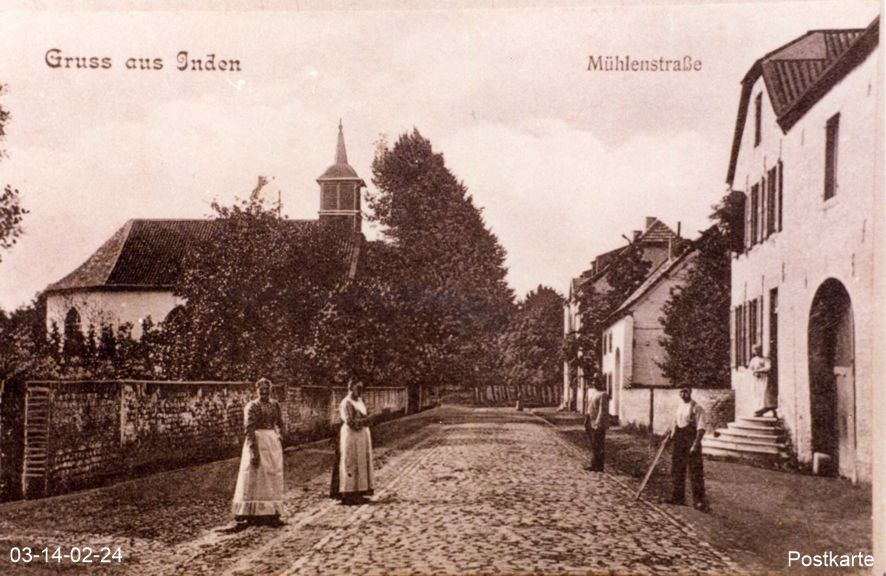
On 13 October 1824, the foundation was formalised. Work began immediately on building their own church, which was situated opposite the ‘Generalsbau’. In popular parlance, the church was affectionately known as the ‘Klömpche’.
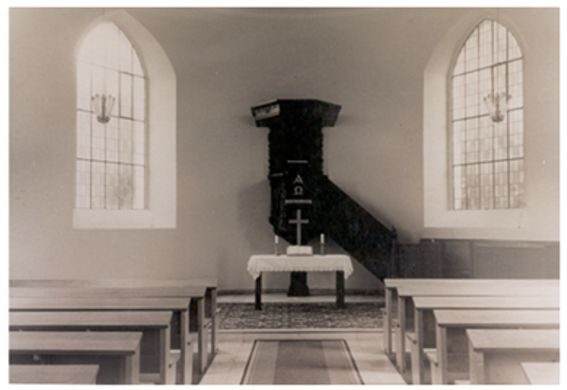
In 1840, the Reformed congregation in Düren donated the pulpit—which still stands in the church today—to the United Church of Inden. The altar is believed to be the original one, consisting of a solid wooden table supported by four columns. It was not until 1854 that an organ from Eschweiler was installed in the church; in 1910, W. Roland from Inden donated a new organ. The original bells did not survive the Second World War; it was not until 1953 that a new iron bell was installed.
In 1965, a second church – the Paul Gerhardt Church – was built and consecrated in the Langerwehe parish area, following the steady growth of the congregation due to the influx of displaced persons and refugees from the eastern territories after 1945. Today, the Protestant parish of Inden has around 1,700 members, half of whom belong to the Inden congregation and half to the Langerwehe congregation.
As part of the resettlement programme, the Protestant parish decided to build a new parish centre at the resettlement site in Inden/Altdorf. The architect was Karlhans Pfleiderer (Neuss). The foundation stone for the new parish centre was laid on 26 April 1997, and it was officially opened on 25 October 1998. The last service in the ‘Klömpche’ took place on 29 June 1997. The furnishings of the old church were restored and transferred to the new building. Three new bells, named ‘solus christus’ (Christ alone), ‘sola gratia’ (by grace alone) and ‘sola fide’ (by faith alone), were purchased and ‘ringed in’ at the foundation-laying ceremony.
In 2021, the floods also affected the parish centre and destroyed the interior fittings. With a great deal of voluntary commitment and support, the members rebuilt it. In 2025, an agreement was reached on cooperation with the Protestant parish of Weisweiler-Dürwiß. Services are held alternately at the two locations.