Railways
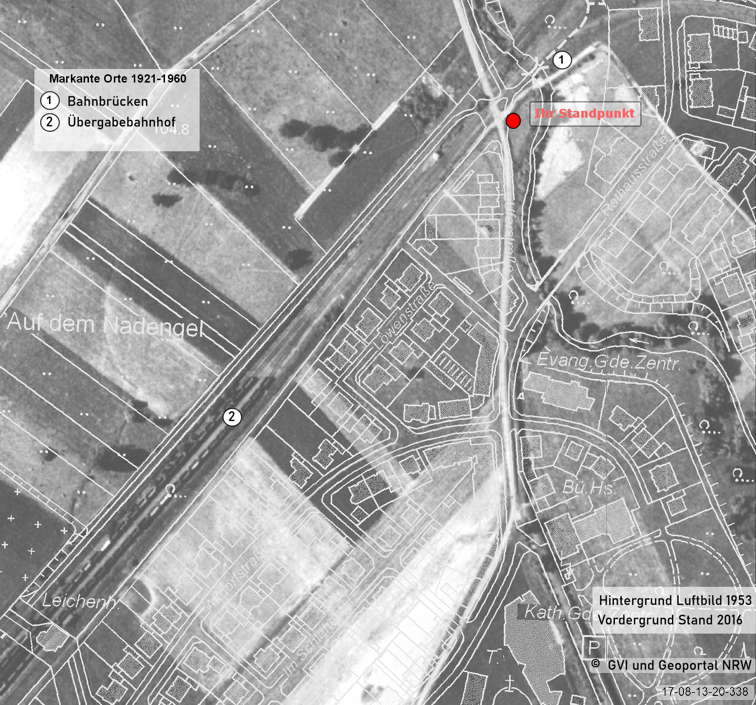
Where the pedestrian bridge stands today, there were once three bridges spanning the Wehebach (1).
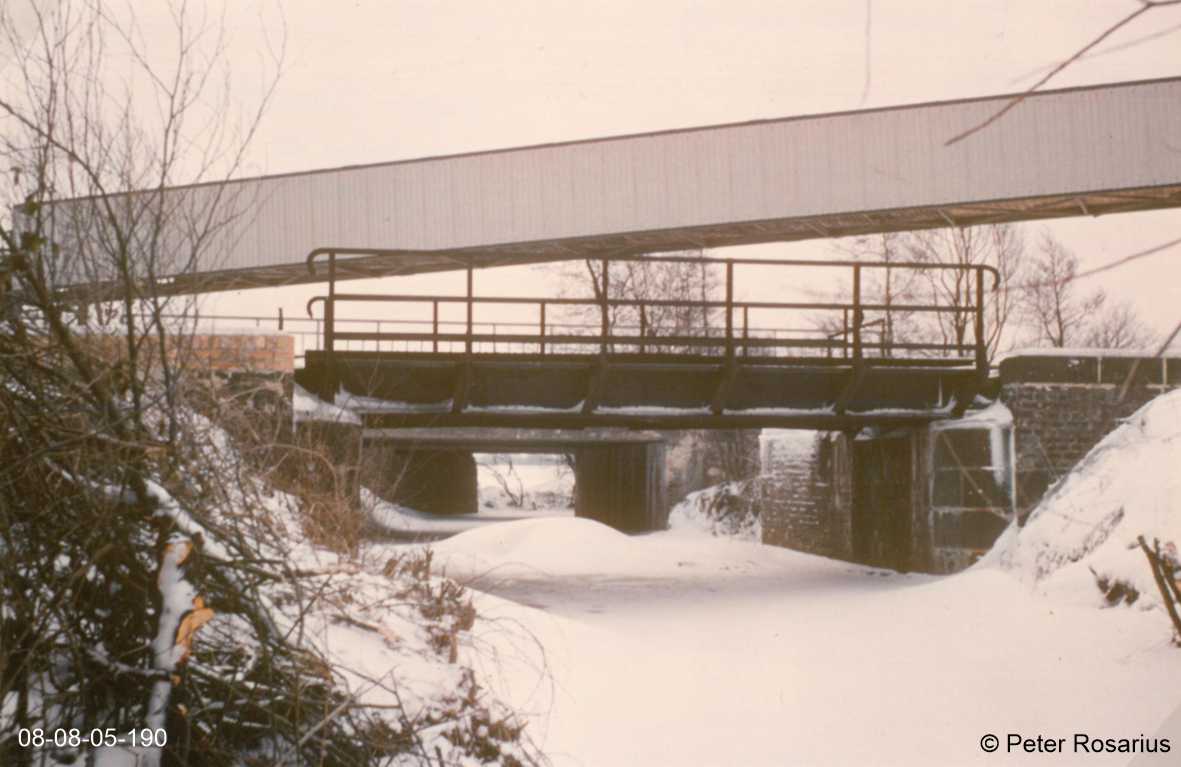
The photograph shows these bridges, looking upstream along the Wehebach from the Lamersdorf side.
The abutments of the Federal Railway bridge can be seen in the background.
The Bergisch–Märkische Railway line between Mönchengladbach, via Jülich and Inden, to Eschweiler-Aue entered service on 1 October 1873. Two years later, Stolberg was connected to the line. From 1888, the line came under the control of the Prussian State Railway. From then on, trains from Mönchengladbach via Jülich, Inden, Eschweiler and Stolberg had direct connections to Aachen and Cologne.
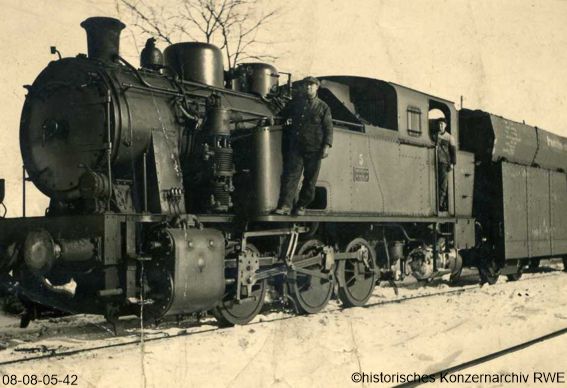
Passenger and freight trains on the line were operated by steam locomotives until the 1950s. From 1955 to 1983, the red railbuses took over passenger services. On 30 May 1983, passenger train services between Stolberg and Jülich were discontinued. Freight services to Frenz continued, as the sidings leading to the RWE power station still branch off there today. From the Frenz stop towards Jülich, the tracks were dismantled.
The middle bridge – the predecessor of today’s footbridge – served as a link between the colliery railway and the transfer station.
In May 1921, the transfer station (2) commenced operations. There, trains carrying briquettes and raw coal were marshalled and handed over for transport via the public railway network. This station extended from this location to the Frenz halt, some 1,000 metres away.
In addition to the public track, this station comprised at least three tracks belonging to the Düren Trade Union – later BIAG-Zukunft – and was connected to the public line at two points. The direct connection to the briquette factory, which had existed since 1900, was linked to the new transfer station as a branch line.
In 1956, coal mining came to an end at the ‘Düren opencast mine’. In 1960, the Lucherberg briquette factory was closed. The transfer station had thus lost its function and was dismantled in the following years, with the site falling into disrepair. Only the wide, dead-straight strip of woodland between the two footpaths leading towards the cemetery and on to Frenz still serves as a reminder today of this once-important railway operation. The mortuary at the Inden/Altdorf cemetery now stands almost exactly in the centre of the former transfer station.
To the right, a remnant of the bridge can be seen, over which the path led from Lamersdorf towards the fields and the loading facility. From 1959 to 1969, a conveyor belt carrying overburden from the Inden opencast mine also spanned all three bridges.