Umsiedlung von Altdorf und Inden
As early as the 1930s, it was clear to the residents of the hamlets belonging to the then municipality of Inden that they might be resettled. In 1935, the National Socialists amended the General German Mining Act to enable large-scale opencast mining as part of their war preparations, which also resulted in resettlements. The Zukunft opencast mine was opened in 1935 and the first bucket-wheel excavator was put into operation. This was followed by the Inden opencast mine with its two sections, I and II. After the Inden opencast mine – which had been suspended from 1969 – resumed operations in 1981, the municipality began concrete planning for the resettlement of the three villages of Inden, Altdorf and Pier. It was the first resettlement in the Rhenish lignite mining area in which
- a sub-centre – in this case Inden – had to be relocated,
- the largest contiguous resettlement of 4,500 residents took place,
- around 60 per cent of its residents were resettled and 60 per cent of the entire municipal area was used for mining,
- around 50 per cent of those resettled were tenants, and
- for the first time, two resettlement sites were designated,
- one of which was outside the municipal area.
- Finally, in 1990, the Environment Minister of the State of North Rhine-Westphalia had spoken out in favour of a phased resettlement of the village of Pier, against the votes of the Lignite Committee; this meant that 1,700 residents were only able to take part in the joint resettlement from 2005 onwards.
The basis for this was the concept of collective resettlement, i.e. a site was to be designated for all those affected by the resettlement where social and economic ties could be maintained. The mining company acquired the land at the current resettlement sites, enabling the resettlers to exchange their plots on an equivalent value basis and to build new homes using the compensation received for their former properties. The same applied to the churches, the town hall, the nursery and the primary school.
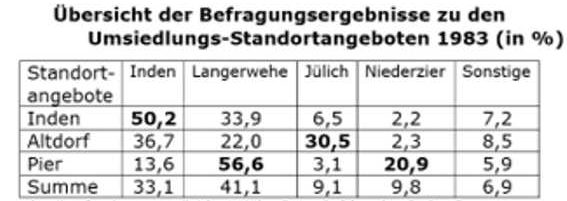
In 1983, the resettlers were consulted by the District President (RP) of Cologne regarding their resettlement preferences. The neighbouring municipalities had also offered building plots.
For the municipality of Inden, the outcome was sobering, as the District President designated two resettlement sites in the lignite mining plan; in addition to Inden-Lamersdorf, the second was in the neighbouring municipality of Langerwehe-Jüngersdorf. In 1990, the Environment Minister of North Rhine-Westphalia decided that Pier should be resettled later (2005–2015) than Inden and Altdorf (1990–2000).
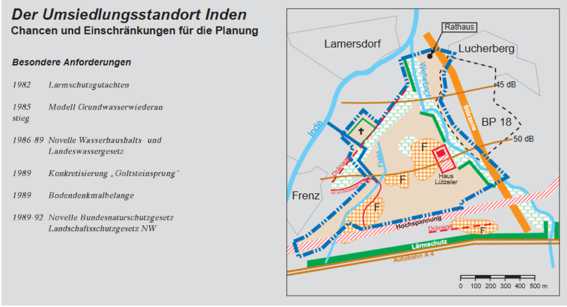
The municipality of Inden planned the current resettlement site around Haus Lützeler, even though this area had a number of restrictions and was therefore dubbed the ‘Bermuda Triangle’. It was the only contiguous area within the municipality that had not been used for mining.
It was centrally located in relation to the other villages, such as Frenz, Lamersdorf and Lucherberg. In 1969 – prior to the local government reorganisation – politicians had already backed the construction of the new Merödgen school complex, which is situated just 300 metres away and forms part of the same development as the future resettlement site.
The resettlement site was planned by the Aachen-based planning firm HelmerMeyerSeiler. The design was based on the historic network of paths around Haus Lützeler. The commercial and administrative centre was planned on Goltsteinstraße.
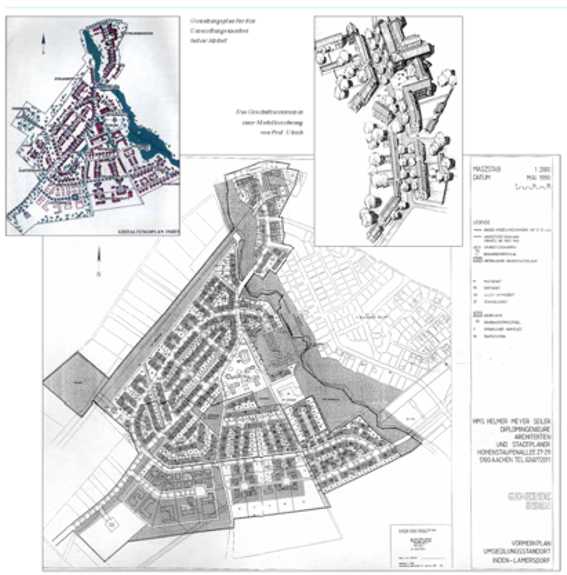
Rathausstraße merges into Hauptstraße and, with its two- and three-storey terraced buildings, leads to the social and cultural centre, which includes churches, a primary school, a nursery and a community centre with a Driesch. The residential area is nestled between a former railway embankment and the Wehebach floodplain. An area along the railway embankment was designated as a village zone so that breeders could keep their pigeons or chickens there – just as they did in the old village. An industrial estate has been designated near the motorway for craft businesses, with adjacent areas set aside for parttime agricultural enterprises.
Farms with livestock were excluded for reasons relating to environmental protection legislation. They have settled in the hamlet of Pattern or at other locations. A noise barrier was built along the A4 motorway. When the village of Pier was able to relocate in 2005, the area east of the Wehebach stream towards the Waagmühle was developed and connected to the village centre by a bridge. The completion of the relocation was celebrated in 1998. The relocation of Pier was also completed in 2013. Around 60 per cent of the resettlers from Inden and Altdorf have settled here on a 56-hectare site at the Inden/Altdorf resettlement location. With 3,867 inhabitants, Inden/Altdorf is now the largest settlement in the municipality of Inden (7,502 inhabitants as at 31 December 2022).