Community Center and Clubs
The Community Hall
Before the relocation, there were still seven restaurants with dining rooms and club rooms in the old towns. Two of them had large halls that could each accommodate 400 people, as well as three bowling alleys. These were places where people celebrated, held dances and town meetings, where clubs gathered and rehearsed, or where people simply met “for a beer” after work.
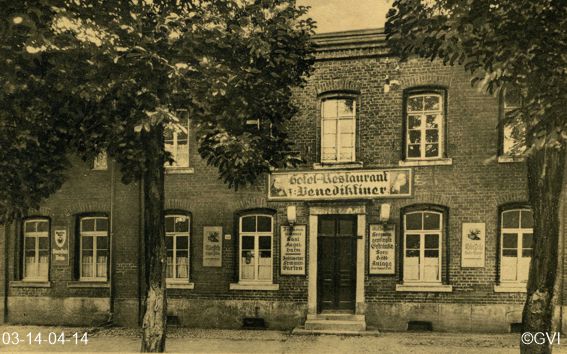
Some restaurants had been in business for generations; the “Treppchen” in Inden, with its ballroom, dated back to the 19th century. Most establishments were run as side businesses and were open only in the evenings or on weekends. No one built a new restaurant as part of the resettlement. The Hagelüken family, a catering business from Altdorf, took the plunge in 1994 and built a restaurant with a hotel, the “Geuenicher Hof,” now (2026) known as the “Olympia.”
In 1994, the town council decided to build a community center with a large hall for 400 people, a kitchen, a coat check, and other rooms. This was intended as a place for local clubs to meet and hold their annual events, but it was also to be available for town meetings and private functions. The location on the Driesch, next to the hotel-restaurant, was ideal. The town reached an agreement with the restaurant to build more extensive shared restroom facilities, a shared passageway, and to allow use of the terrace facing the Driesch. It was completed in 1997.
The municipality of Inden financed the construction in part through urban development grants. The rooms are available for rent.
The Village Clubs
Club life in the old villages of Inden and Altdorf dates to the Middle Ages. The first associations were likely the shooting clubs, which have always been committed to the principles of “faith, tradition, and homeland” and originally served as a kind of vigilante group.
But communities such as sports clubs, choirs, music clubs, and especially here in the Rhineland carnival clubs and May societies also enriched village life.
With the merger of the villages resulting from the resettlement, it became necessary for the clubs to merge as well, because the town was simply too small to sustain two identical clubs. The two drum and fife corps were among the few exceptions to this rule. The marching band from Inden was founded in 1922, and the marching band from Altdorf in 1923. After the resettlement, both clubs continued to exist side by side for several years until they, too, finally merged in 2010.
As an example of the many clubs, the history of the shooting clubs is worth mentioning here. You can discover the history of the other clubs by scanning the QR code in the additional information.
The Inden Shooting Brotherhood is first mentioned in 1424, when Knight Daim von Bruch of Geuenich made a donation to the St. Anna Brotherhood in Inden. The brotherhoods of Inden and Altdorf (founded in 1433) are united under the name St. Anna. In 1806, Altdorf was elevated to parish status, and since then the Inden brotherhood has borne the name St. Sebastianus and the Altdorf brotherhood the name St. Pankratius, after the patron saint of their respective chapels.
During World War II, the Altdorf Shooting Brotherhood lost its brotherhood book, two flags, and all its uniforms. The royal silver was buried and thus saved. On February 22, 1948, while the village was still being rebuilt, the first postwar bylaws were adopted.
In 1947, the first post-war patron saint’s festival, combined with the general assembly of the Inden Shooting Brotherhood, took place. The first shooting festival was celebrated as early as May.
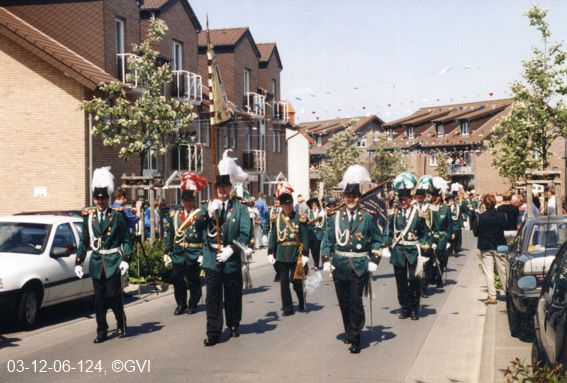
Due to the impending relocation, initial discussions regarding a merger were held in 1990 between the brotherhoods of Inden and Altdorf. At the new location, they were to merge under the new name “St. Sebastianus and St. Pankratius Inden/Altdorf 1424/33 e.V. Shooting Club.”
On June 28, 1995, the Pankratius shooters from Altdorf joined the Sebastianus Shooting Club from Inden, thereby completing the merger.