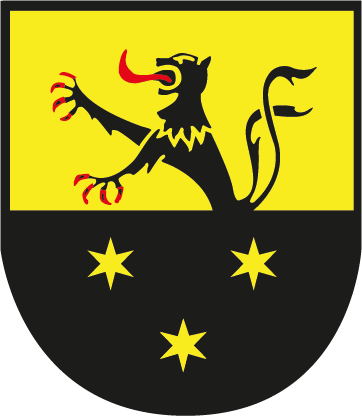
A Look Back at Pier
Pier has a long history of settlement. Matron stones, which were incorporated into Frankish graves, probably originate from a Roman temple complex not far from the village – as archaeological finds suggest. It is certain that Pier was settled in the Early Middle Ages. This is evidenced by Merovingian graves from the 6th century, which were discovered beneath the church and at another site in the village.
A church with a parish is first mentioned in writing in 922. Until 1804, the parish of Pier included Jüngersdorf, Stütgerloch, Luchem, Lucherberg, Merken, Schophoven with Müllenark, Pommenich and Vilvenich; Bonsdorf was added in 1806. The village has several estates belonging to various monasteries, such as Gerresheim and Brauweiler.
From the High Middle Ages onwards, the Counts, and later the Dukes of Jülich, shaped the lives of the people for centuries. The villages of the Pier parish form the Pier–Merken judicial district. In this judicial district, lay judges administer justice and manage civil community affairs. For several generations, the respective Baron of Müllenark has served as the bailiff of the Pier–Merken judicial district. Court hearings usually take place there at Müllenark.
Since the 18th century, several Jewish families have lived in Pier. Their burial ground is situated about 1.2 km north of the village, by the Lendersdorf mill pond.
With the invasion of the French Revolutionary Army in 1794, the days of the Duke of Jülich were numbered. Church and monastery property was expropriated and sold off. New administrative structures replaced the old local courts. Under Prussian rule, in 1816 the French ‘mairie’ became the Pier mayor’s office, comprising the villages of Pier, Schophoven, Lucherberg, Luchem, Jüngersdorf and Stütgerloch. In 1934, the mayor’s office was merged into the Lucherberg district.
Pier remained predominantly agricultural throughout the 19th century. Workers employed in the surrounding industrial areas sometimes had to endure long walks to get to work. In 1903, the A. Heymann rag sorting plant was established in Pier; alongside the existing Wirtz brewery, it remained the only major employer in the village for a long time.
In 1908, Pier became the terminus of the tram line from Düren, which served both passenger and freight transport. In 1927, the line was extended to Inden. In 1965, passenger services were replaced by bus services, freight services were discontinued and the tracks were dismantled.
Electricity was first supplied to the village in 1908, whilst a water main was not constructed until between 1939 and 1941.
The Second World War, triggered by the Nazi regime’s delusions of grandeur, took a heavy toll. A resident of Pier, who was a supporter of the Communist Party, was murdered in a concentration camp. The members of the Jewish family Cahn still living in Pier are considered missing. Further information about the Jewish residents can be found on the plaque ‘N02 In Memory of the Jewish Residents’.
The fighting between American and German troops over the Inde and Rur river crossings in the autumn/winter of 1944–45 left large parts of the region in ruins. The situation in Pier was particularly dire. By the end of the war, not a single building there remained undamaged; the village was almost uninhabitable. Many years after the war ended, the destroyed houses were rebuilt and new settlements sprang up.
In the mid-1960s, an apparatus manufacturing company and a mechanical and steel engineering firm established themselves on the derelict site of the former rag sorting plant and in its immediate vicinity. After 1971, the Pier industrial estate was developed north of the River Rur, around the excavation pit of a former gravel quarry.
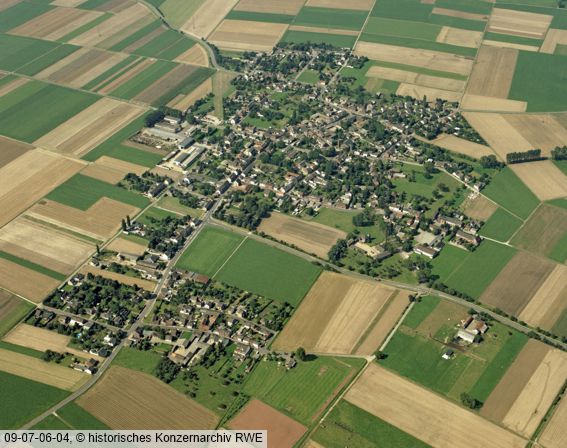
March 2005: Start of the resettlement
May 2008: Last service in the Pier church
February 2012: Demolition of the church
September 2013: The resettlement is complete
The old Pier no longer exists; the name lives on as an independent district at the resettlement site of Langerwehe-Pier. Find out more about the relocation at the “S05 Umsiedlung Pier” station.