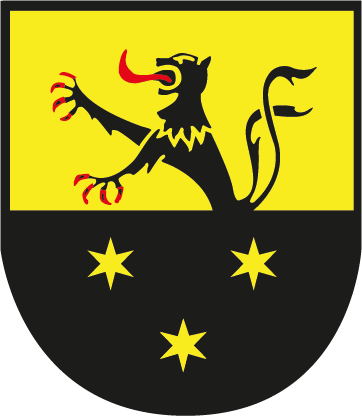
Geuenich
The small hamlet of Geuenich once stood on the hill between Inden, Altdorf and Pattern. The settlement was continuously inhabited from the 5th century AD until 4 October 1678. On that day, French troops under the ‘Sun King’, Louis XIV, burnt down 18 villages along the Rur and Inde rivers. Among them was Geuenich, which consisted of just three farmsteads and the church. The farmsteads were never rebuilt; the inhabitants fled to Inden and settled there.
The Church of St Remigius was provisionally repaired; from the Middle Ages until 1804, it had served as the parish church for the villages of Inden, Altdorf and Pattern. The parish priest was appointed by Wenau Abbey, which owned the church until 1804. All three villages in the parish had their own chapels. However, only devotions and weekday Masses were held in these; Sunday Masses, baptisms, weddings and major church festivals took place in the mother church at Geuenich; this meant long journeys for the faithful in all weathers. The deceased from Altdorf were buried in the churchyard at Geuenich Church, as there was no space at the village chapel; in Pattern and Inden, funerals took place at the chapels in the centre of the village.
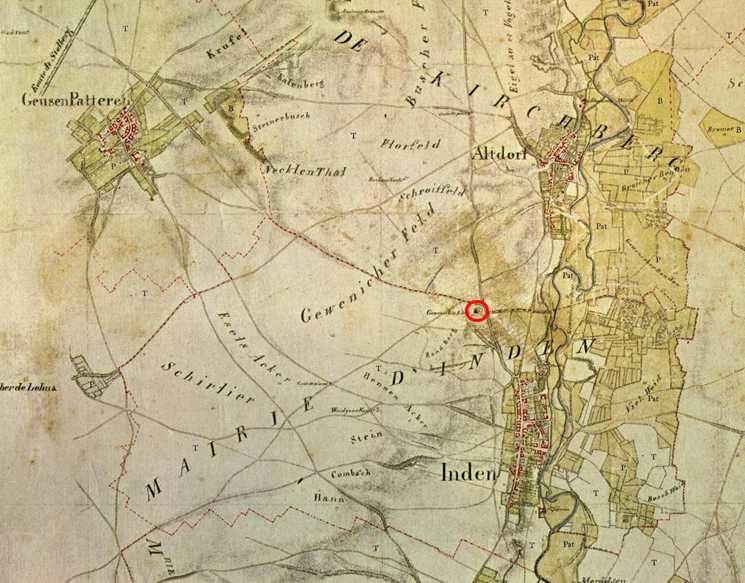
In 1804, the Geuenich parish was abolished by the French occupying forces; Inden and Pattern became independent, whilst Altdorf remained a branch parish under Inden. The church’s furnishings and bells were taken to Inden. The church itself stood abandoned on the hilltop and fell into disrepair. It was demolished in 1824.
In 1806, the people of Altdorf achieved their long-awaited elevation to a parish. However, the people of Inden refused to part with any of the Geuenich church’s furnishings, particularly a small statue of the parish patron saint, Remigius. This led to fierce disputes, culminating in a mass brawl, which could only be ended by the deployment of French soldiers. The long-standing dispute was finally settled in 1817 by the district administrator of the Jülich district: the assets of the Geuenich church were divided between Inden and Altdorf according to the number of Catholic parishioners, whilst Altdorf received the bells.
In 1854, four lime trees were planted and a cross erected on the site of the former Geuenich church. In 1926, a memorial to the fallen from Inden in the First World War was erected here, and in 1955 it was expanded to include the victims of the Second World War.
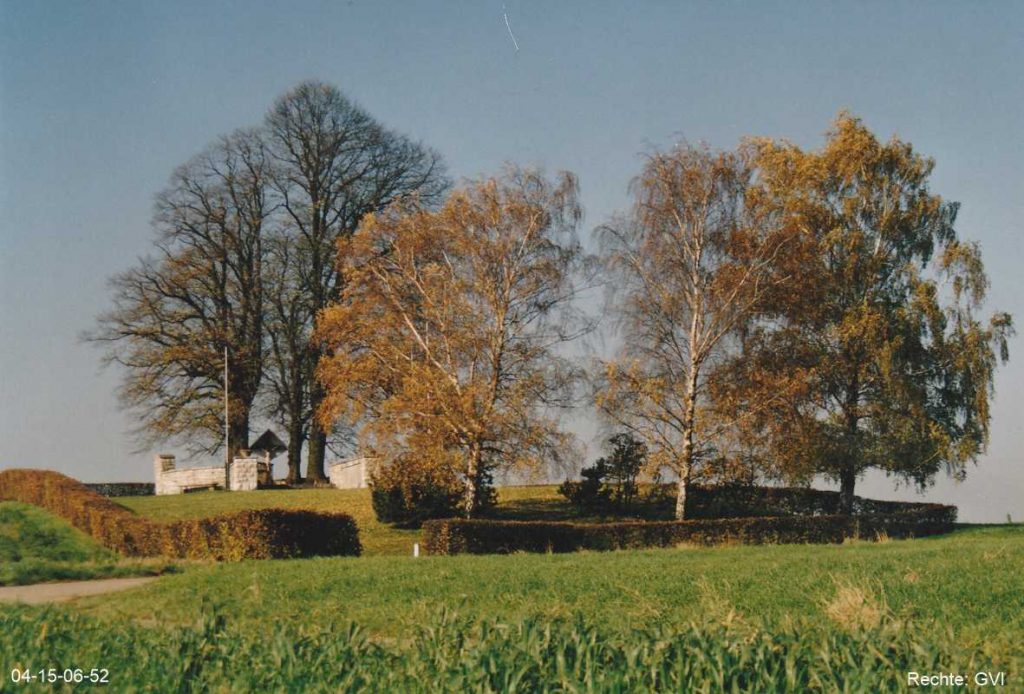
Due to the encroaching opencast lignite mine, the original memorial was dismantled in 1998 by the Kyffhäuser Kameradschaft Inden/Altdorf e.V. and reerected here, expanded to include the names of Altdorf’s war victims. Members of the chapel building association founded by the Kyffhäuser Kameradschaft secured building components and materials during the resettlement of Altdorf and Inden. Using these, they built the chapel by 2007. More information can be found inside the chapel.