Local Cemetery
Ever since Christian churches were established in the villages, the deceased were laid to rest in the immediate vicinity of the places of worship. Those of high social standing were often granted a burial place inside the church. In the Middle Ages, according to the religious beliefs of the time, the gates of heaven were closed to stillborn children and infants who died unbaptised. Consequently, the gates of heaven were opened to these children by burying them along the eaves of the churches. It was believed that rainwater which came into contact with the church roof had the same effect as baptismal water. These ‘eaves children’ were discovered during archaeological excavations at the Catholic church in Inden.
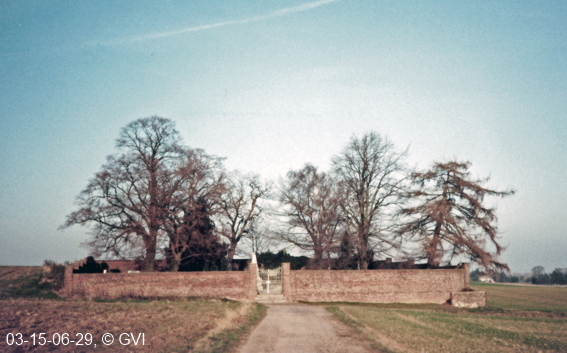
In 1820, the Reformed community in Inden consecrated their own cemetery in the immediate vicinity of the former Geuenich church. This cemetery, ‘Am Bongard’ – colloquially and jokingly known as ‘et Möischekämpche’ – was most recently listed as a protected monument. In the centuries prior to this, the Protestant deceased were buried in Jülich or, if this was not possible due to flooding of the Inde and Rur rivers, in their own gardens.
Nach dem Tod des letzten Bonsdorfer Pfarrers wurde die Kirche 1844 abgerissen. Auf dem sie umgebenden Friedhof wurde bis 1947 beerdigt, 1950 wurde er geschlossen und 1970 entwidmet.
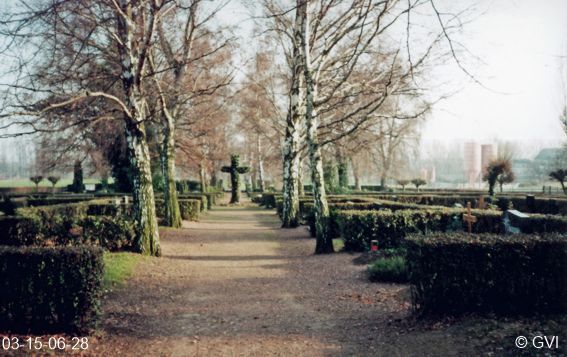
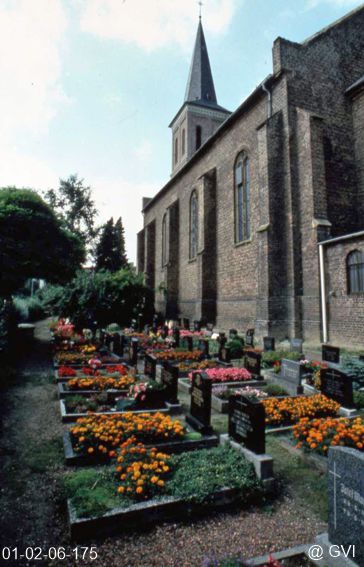
Due to the sharp rise in the population, the Catholic cemetery at Inden Church was closed at the end of 1924, and since then the newly established municipal cemetery on the L241 road to Altdorf has been in use.
In Altdorf, there were still a few graves at Altdorf Church; all the others were at the municipal cemetery, situated approximately one kilometre from the Inden cemetery and located on the L241 road.
The resettlement of the inhabitants also involved the exhumation and reburial of all the deceased. As the resettlement site at Inden/Altdorf lies within the floodplain of the Wehebach, the hydrological soil conditions were extremely unfavourable for the establishment of a cemetery. Expert reports were drawn up and calculations made regarding the size of the future cemetery. It was to be a municipal cemetery to which all the deceased from the cemeteries in Altdorf and Inden could be reinterred. This was to be situated outside the resettlement area. Originally, the sports ground was also planned to be located in the vicinity of the cemetery. However, this did not meet with the approval of the local community. In 1991, the local council decided to locate the cemetery alongside the former railway line, within walking distance of the village churches.
The excavated soil from the civil engineering works at the relocation site was used for backfilling to raise the ground to the level required for the future graves. A cemetery by-law was drawn up, which made it possible to retain the boundary walls of the old graves. The cemetery was designed by the landscape architecture firm Hallmann & Rohn (Aachen); the cemetery chapel was designed by the architect Johannes Schoeller from Langerwehe.
Burials at the cemetery began in 1994. The reinterment of remains from Inden and Altdorf began in November 1994 and continued for several years.
All abandoned graves from the old cemeteries in Inden and Altdorf were reinterred in a communal grave and thus no longer have their own burial plots. The high cross stands on the hill at the far end of this cemetery. The communal grave and an anonymous urn field are located within this hill. The remains from the archaeological excavations – particularly those in Geuenich – which had been scientifically examined, were also interred in this communal grave after being cremated and placed in 90 urns. The reinterments from the Pier cemetery took place between autumn 2008 and winter 2011, predominantly to Langerwehe-Pier.
On the slope running parallel to the burial mound at Hochkreuz lie the war graves from Altdorf and Inden.
Not all the graves of honour from the old villages were retained following the reinterments. Those for which there were no longer any surviving relatives were abandoned. Others, such as the five priests from the crypt of Pierer Church, were reinterred in 2007 at the new cemetery in Inden/Altdorf.