
Lützeler Estate
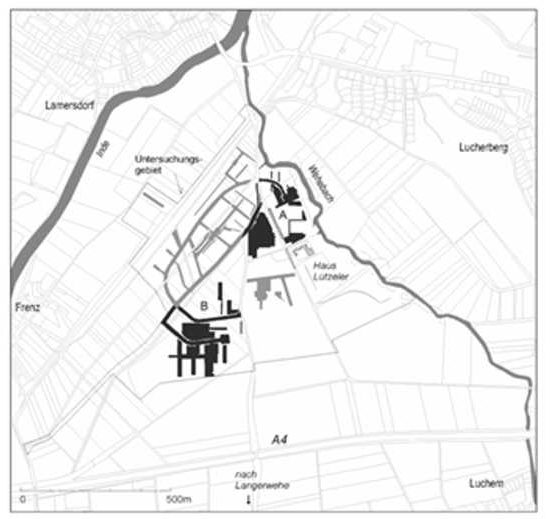
Archaeological investigations (1991–1993) revealed that the Inden/Altdorf settlement site had been inhabited by the Romans, with several interruptions, as early as the 1st and 3rd centuries respectively. At times, the area was developed in a scattered settlement pattern and, by the 7th century, had consolidated into two estates (Lützeler Estate ‘A’ and ‘B’). Only the Niederburg (= lowland castle), the Lützeler noble residence, has survived.
The once stately farmstead has a long history dating back to the 14th century: the name Lützeler is derived from its former owner, Junker Johann Vruntgin von Lutzelen. The spelling has changed frequently: Lützen – Lutzelen – Lützenich – Lutzenem – Lützeln.
From 1626 onwards, it was spelt consistently as Lützeler or Lützler. In 1393, Junker Johann Vruntgin von Lutzelen appears in records; in 1398, he sold his estate at Lucherberg to Carsilius von Palant of Breidenbend. At the same time, he acquired the estate at Lutzeler from Peter von Loyvenberg, a lay judge of the city of Aachen, his wife and her sister. They appear to have belonged to the Vruntgin family and thus to the Palandt family. It is not known how long they owned the estate. The owners changed frequently.
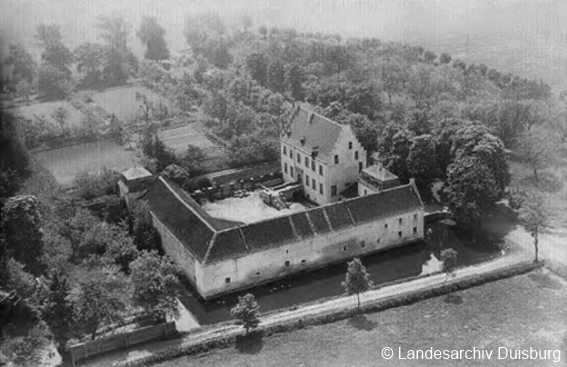
Thus, at the end of the 16th century, Bernard von Merode, Lord of Rummen, held the annuity. On 20 July 1840, the farmstead, which belonged to the municipality of Langerwehe, was sold at public auction. In 1844, the Scheuer family acquired the farm. They owned it until it was sold to RWE (now RWE Power AG) so that the company could develop the present-day resettlement site of Inden/Altdorf on the only contiguous open space within the municipal area not occupied by opencast mining.
Originally, Haus Lützeler was a rectangular farmstead dating from the 17th–18th centuries, enclosed on three sides by buildings.
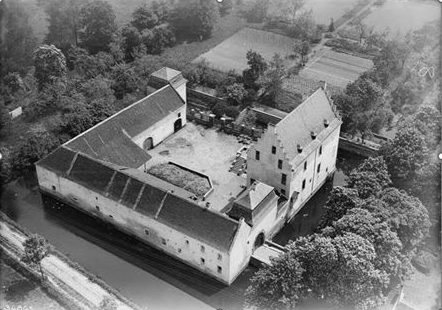
To the south-west stood a 16th-century manor house; to the south, the farmstead was not built upon, but beyond the moat lay a garden. The estate was surrounded by wide moats, meaning that the manor house could only be reached via two drawbridges. In the Middle Ages, the complex was expanded to include two further moats, situated 20 metres and 100 metres from the main moat respectively.
The outer moats were filled in after the Second World War.
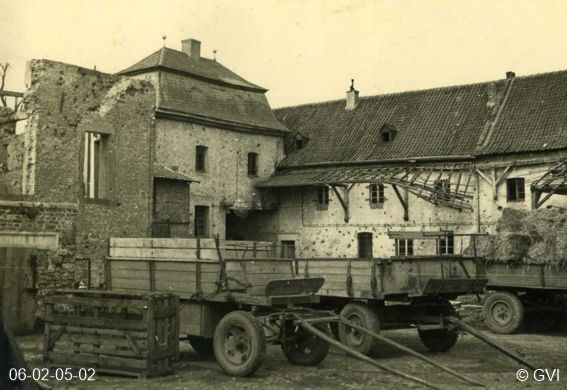
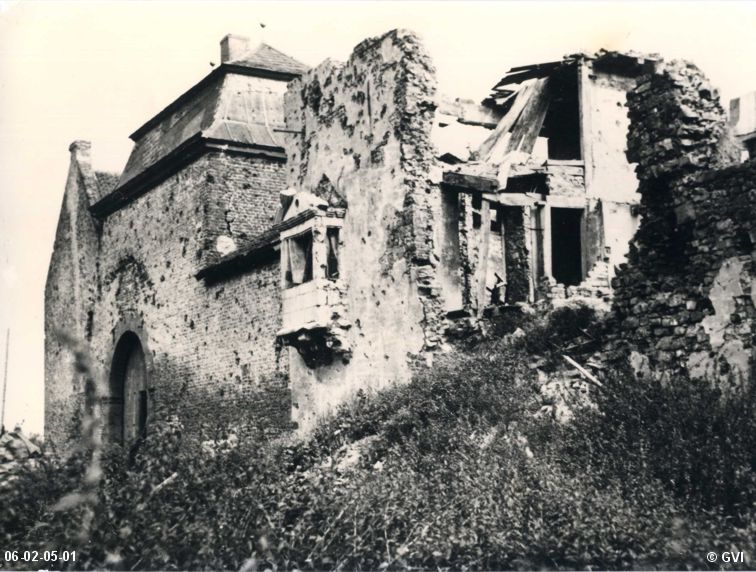
During the Second World War, the manor house was destroyed and not rebuilt; Haus Lützeler also suffered considerable damage to its outbuildings.
In 1990, the area around Haus Lützeler – comprising the churches, the primary school, the nursery and the Driesch – became the socio-cultural centre of the resettlement area. In the late 1990s, RWE sold the listed property to a property developer, who renovated it. The outbuildings were converted into private homes, whilst new owner-occupied flats were built on the site of the former manor house.
The former gardens were designated as a residential area (now Pumpengasse). The former filled-in moat that surrounded the gardens is now a public green space marked by a hedge running along Geuenicher Straße, and is still recognisable today.